Category: Beliefs

  • Skimming Stones

    In an attempt to skim a stone the young child threw it into the air only for it to splash into the water and immediately sink

    The adult teaching the child managed to successfully skim the stone across the surface of the water.

    Later I began to think of how the stone represents information. How this information skims across the mind of an adult yet is easily absorbed by the child.

    It’s my experience that the older we get the less inclined we are to digesting new information. Especially when this information questions established models and belief systems

    To continue with the metaphor. To skim a stone we need to put in a great deal of effort. Getting it to skim across the surface tension of the water takes effort. Without realising the effort and technique required the child just threw the stone into the air. Moving slowly and directly downward the stone easily broke through the surface of the water.

    I recently read about a madman who had thousands of books he never read. He never read them because he was so certain in his already established beliefs. As a result, millions of people died. You might guess who I’m talking about.

    When we yield and finally decide to stop working so hard to remain fixed in our ideas and beliefs (that may have stopped working years ago) change can happen

    It takes more effort to remain stuck and unhappy than we realise. When new information isn’t properly, mindfully considered, it’s like the stone travelling quickly over the surface of the water. It skims across the surface of the mind as if it were never there. We remain unchanged and unhappy.

    Although new information can initially feel like someone’s throwing small stones at us that sting, once absorbed, we will eventually gain a different way of seeing things. Learning to meditate can help with this process.

  • Mindful Protection

    Gently bring the mind back into the present moment through focusing on the breath

    On the occasions, when we choose to open our minds to what the media is showing us, it seems like the world has gone mad. Has it ever been any different? Large scale conflicts are only symbolic of the turmoil and conflict our leaders are facing. Warped ideology (from our perspective) anger, fear, the need for control, the ego, et cetera, et cetera. All symptomatic of minds out of control.

    Take control of your mind. Take control of your life

    Self consciousness, self awareness, call it what you will. The greater our awareness of thoughts, and how they dictate the kind of life we live, the better. There are those who thrive on chaos. In fact they long for it because it’s all they know. I can relate to this. For much of my time I rejected all that was good in my life through my minds need to feed its addiction to chaos. Constant stimulation. Constant craving. The constant need to ease my loneliness. A loneliness fed by my need for chaos. Can you see the destructive cycle I was in? This is what so many of us are doing: Seeking to ease our loneliness. In the process, our minds take us unceasingly toward what we refuse to look at: Our fear and loneliness. It is us that’s creating the destructive cycle. It is our minds attempt to understand. Great leaders and philosophers of the past knew this and looked to help humanity in its struggles. Until we break the cycle, how will we ever understand? We cannot read and implement what the great leaders of the past taught us without first becoming aware.

    The solution, countless enlightened individuals have found is, mindfulness

    With practice we can get to the root of what we are. We can find a calmness of mind, underneath the chaos, that reveals pure awareness. When we have this, we’re able to notice all the beauty that surrounds us.

    Personal circumstances matter not. There is suffering, yet our suffering can be eased, when we have clear insight into how it is us that amplifies our self-destructive tendency.

    We could choose anger

    Mindfulness helps us understand, it’s what we choose, that determines the quality of life we experience. No matter your circumstances, through learning how to take control of your mind, you empower yourself to make the right choices. If you want purpose in your life make it the development of mindfulness. Develop a beautiful mind. People with purpose make their own choices. Not those dictated to them by others.

  • Mindful of Your Kind

    Photo by Lisa from Pexels on Pexels.com

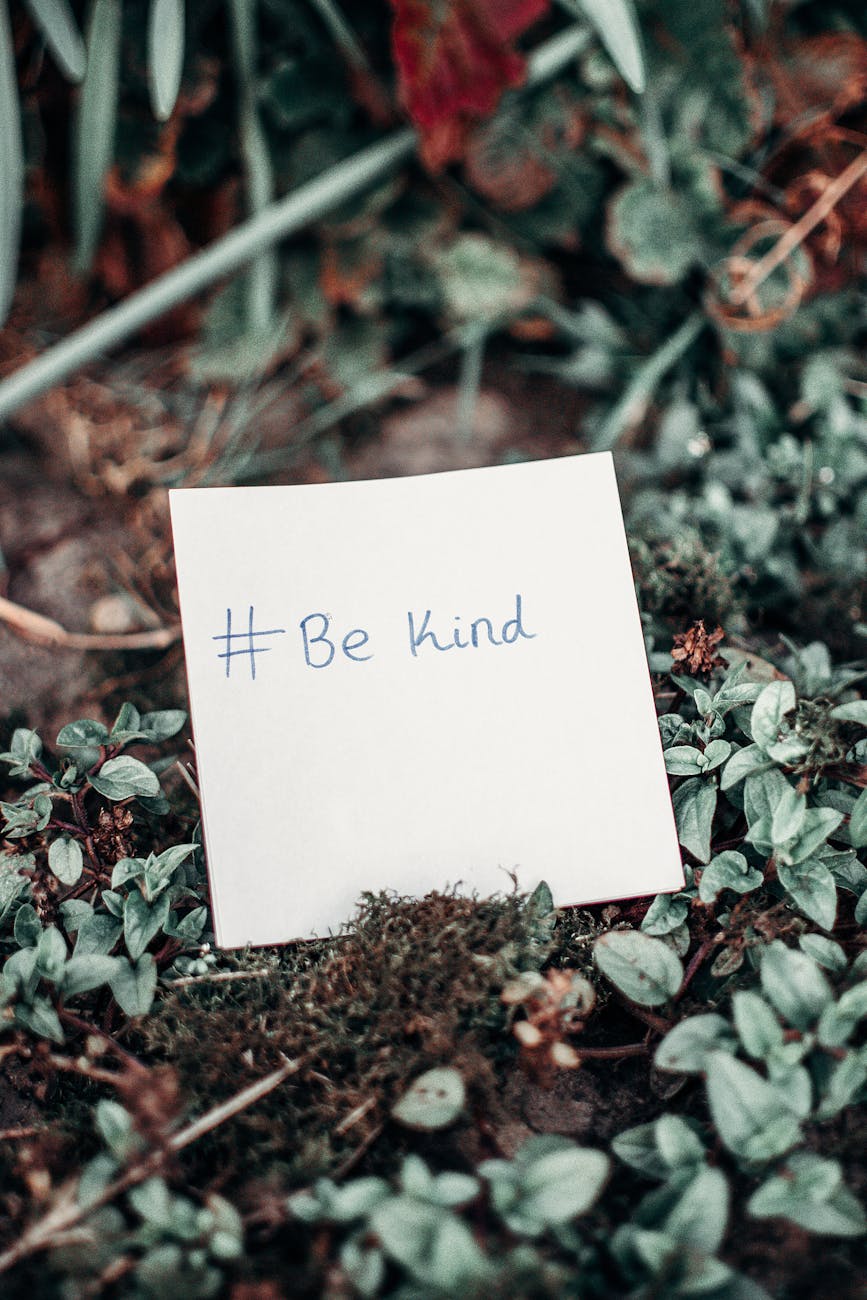
    Kindness is the language which the deaf can hear and the blind can see – Mark Twain

    Being mindful of the limitations, and dare I say it, the stupidity of others, is an act of kindness to oneself. As time goes on, the divide can only get bigger. . . this divide between the mindful and the forgetful.

    I think, ultimately, the survival of the species depends on it. There are those who are awake and aware, and there are those who are not. And we must be kind. Because they really do not know what they do. It is, as Mark Twain points out, a question of kindness.

    Mindful people gently get on with their day, spreading a little kindness, where they can

    I believe now that it is the quiet and gentle curiosity of the behaviour of others that will demonstrate how we must be.

    Without judgement, we can pause and reflect on how the majority live. We can then ask: What must I do to live a better life?

    When observing the difficulties others face, we can ask: What could that person do to move forward in their life? How can they move on from their pain?

    How can I use kindness to help this person remember love? How can I help them become aware? And, of course, a genuine kindness can only be offered to others when we’re able to offer it to ourselves.

    By noticing the strength of racism, prejudice, and hatred in society, we can gauge the level of fear

    There are those who believe they are in some way better than others. They believe they are superior. I have been pulled up on highlighting this fact because in the process of this, I’m being hypocritical. I’m making a judgement and forming an opinion. The very thing we should avoid if we want a peaceful life. It’s a struggle to find the right balance with this.

    Do we remain quiet? Do we become indifferent to fear and hatred? Or do we briefly place ourselves above it in order to show people what the real issue is?

    For me, when I simplify humanities’ struggles as being a fight between love and fear, I’m able to allow my own fear to subside gently. What purpose does it serve for me to become emotionally upset at what I see? The emotion drives me to seek answers and understanding. When I have this, my equanimity returns.

  • Mindfully Emotionally Whole

    Image by Gerd Altmann from Pixabay

    Being made aware of what wholeness is and its importance for health and happiness is the first step

    Wholeness, as the word would suggest, is the capacity to embrace all aspects of the self. To become emotionally whole, we must be able to experience and accept the whole spectrum of human emotions in a way that encourages their free movement. Put another way, we must free ourselves from the habit of judging our emotions as being either good or bad. In addition, we must acknowledge the possibility that we have suppressed certain emotions (parts of ourselves) due to past trauma.

    There can be many ways in which we keep our emotional selves buried. It’s very straightforward. We may need to bury ourselves in books of a certain genre, take drugs, only ever listen to uplifting pop music, or obsessively pursue anything that takes the mind out of the present moment

    AI Generated Image

    The exact mechanism used to distract ourselves isn’t that important. What is important is acknowledging that we can be better at accepting all of our emotions as being equally important. Take a moment and consider what your reaction is to the concept of emotional blockages leading to illness in the body.

    For me, this idea has great value. And it really matters, not a jot, whether it remains a concept or becomes accepted fact. If we believe that emotions can become trapped in the body, and release and acceptance of these emotions helps us to feel better in the long term, this is what truly matters. I believe meditation, which leads to improved everyday mindfulness of how we avoid emotional wholeness, is key to our mental and physical well-being.

  • Finding Refuge Through Meditation and Mindfulness

    Whenever I find myself feeling anxious or overly emotional, I remind myself, of what my skills of meditation and mindfulness offer me. The knowledge that I have these tools, easily at my disposal, instantly reassures me

    It doesn’t matter what our age or circumstances there are going to be times when we feel troubled. It’s life. Life is meant to challenge us from time to time. It’s part of the process. It’s not possible for us to grow and experience the full kaleidoscope, of what life has to offer us, if we’re not occasionally challenged.

    Meditation leads to an improved level of stillness and calm that comes from everyday mindfulness

    It’s common nowadays for people to comment on how calm they find me. They describe me as a ‘calming influence’ and this is something I’m proud of. I’m proud because this has not always been the case. Quite the opposite in fact.

    I have, in the past, allowed my emotions to control my actions. This can of course be disastrous. And so, as a result of improving my mental fitness – through daily meditation – I’m capable of being increasingly mindful. I’m mindful of how my judgments, opinions, beliefs, thoughts and emotions, influence my behavior and, above all, my choices. When I’m troubled, I take refuge in my practice. I dedicate time to calm myself before making decisions or taking action.

  • Responding to Aggression with Love and Humility

    Some will always fight fire with fire. The healthy response for mind and body is to extinguish aggression with the cool, quenching powers, of love and humility

    When the bully told the boy: “get down on your knees and kiss my feet” how powerful would it have been if the victim had said: “certainly sir and would you like me to polish your shoes whilst I’m down there?”

    Firstly, we can look at the need of the bully to dominate. There is a likelihood that the bully had experienced a high degree of humiliation from a parent or other adult and needed to inflict this pain on others. This of course doesn’t make it right and yet it helps us understand the child’s pain.

    Secondly, we must look at the strength and courage it would have taken for the victim to respond to the bully with love, humour, and humility. The child victim of the bully would have needed an informed and developed consciousness. He would have needed to be aware, present, and mindful of his words and actions. He would have needed the ability to consider cause and effect. He would have needed to be considered.

    Developing and informing our children is were the answers lie

    The consequences of the majority of us responding to aggression with love and humility are not difficult to see. We would certainly live in a quieter, more peaceful, world. And it is the case, that compared to the past, we already live in a better world. For us to grow and build on this success, we must keep a keen eye on how our children choose to respond to aggression. They can easily be taught the peaceful path when offered love and humility from us adults.

  • Be Mindful of the Power of Belief

    I grew up with religion. My parents were Roman Catholic. As soon as I was able to leave my childhood home, I rejected religion completely. At least consciously. As a result of my experiences of religion and my training in the psychology of beliefs later in life, I came to understand, at a deep level, how powerful and influential our beliefs are.

    The next time you get the opportunity, if you want to experience the power of beliefs firsthand, visit a large building built through the belief in God. Pause and take it all in.

    In my mind, as may be the case with yourself, religion isn’t fact, only belief. Even so, look at what humans do simply through the power of their beliefs. Always be mindful of what you choose to believe, fact or fiction, you can see it with your own two eyes.

  • The Mindfulness Tool

    If it hasn’t happened already there will come a time when you’ll try and do a job without the correct tools

    In a sense much of the troubles we encounter in life can be down to using the wrong tools or not sufficiently developing the correct ones. I recently decided to replace the front suspension on my car. All was well until I tried to tighten a particular nut. In order to tighten it sufficiently, it became apparent, that a particular tool was required. I had no idea this tool even existed until I researched it. I knew the centre spindle – of what I was tightening the nut onto – needed securing in some way, but had no way of doing it. I’d worked out how it could be done, but knew of no tool on the market that would be up to the job. I searched the internet and discovered the tool required was called a ‘go through ratchet.’

    Put simply, it enables you to place an alum key through the centre of the ratchet – to hold a spindle still – whilst tightening the nut. A very simple solution that you’d have no idea existed until you took some time to research it. And without the proper tightness on this nut all sorts of problems can arise. From an annoying rattle, to parts wearing out much quicker than they should. You wouldn’t believe the satisfaction I’ve receive from finding the correct tool, that makes a job not just possible, but effortless.

    There are several tools required before you’ll be able to improve you’re level of mindfulness. The first is patience and the second is meditation. Without patience, meditation will be unpleasant, and without meditation, mindfulness will never be fully achieved

    I would suggest the first tool to attain is patience. The tool of patience does come with time, however, no matter how old a person might become they may never learn patience. I believe we develop the tool of patience when we become less fearful. All we need do is ask: How is it I’m in such a rush? What is my frustration? How is it I lack understanding?

    Perhaps compassion will also help us with patience. Yes, we must have understanding and compassion. We must also have very little fear; whether that be a fear of loss, a fear of not being understood – or whatever our fear might be – that’s causing our lack of patience.

    When it comes to meditation, our lack of patience, might be the result of our unwillingness to work as hard as is required to become effective

    Another interesting thing to consider is our self-belief. Do we believe we’re capable. If we lack self-belief this can lead to us trying to use the wrong tools (Meditation/Mindfulness apps?). In addition, attempting to do a job without the proper tools can be a symptom of these kind of beliefs: I always get things wrong. I find things too difficult. I lack patience.

    How will we ever develop patience if we believe something is too difficult. Believing things are beyond our ability will cause us to lose patience and give up.

    For me to complete the job I set out to do, I needed to firstly take a breath, and then use the tool of patience to gain a better understanding, of what I was attempting to do. All I was finding, without the correct tool, was frustration and anger. Now I have the tools and understanding I can finish the job and revel in the feelings of satisfaction that will come with this.

    The degree of mindfulness we achieve will be determined by our mental fitness. Mental fitness is improved through meditation. Meditation becomes a pleasant activity once we have the tool of patience at our disposal. So remember:

    • The tool of patience comes when we are fearless and have understanding and compassion toward ourselves and each other
    • Meditation becomes a pleasant activity once we have patience in our toolbelt
    • Our level of mindfulness is improved through the mental fitness regular meditation awards us

  • Silence or You’ll Get What You Want

    In an interesting experiment I found that I got exactly what I didn’t and did want

    If ever you’ve looked to sell something, you’ll know, that the best way to achieve this (and remain calm) is, to accept that human beings are very curious creatures indeed. There are people who want the item you’re selling but can’t afford it. So these dreamers, in an attempt to feel closer to their dreams, will seek to waste your time in all manner of ways. There are serious buyers who simply refuse to pay what the item is worth (to you) so will also waste your time. And there are those who see an item, decide it’s worth, believe it’s genuine, make a decision, and then buy. I love these individuals. There are of course further examples of the type of people you’re likely to encounter but the three above are the main ones.

    When advertising your item, keep it simple and, in order to remain calm, remember the code of accepting you’ll get all manner of odd replies. If you don’t have the time or inclination don’t reply

    Something I’m currently advertising for sale is a motorcycle. Love them or loath them it seems to be a thriving market at the moment, and with the new season just around the corner, now is a good time to be selling. At the bottom of my ad I wrote: Serious contenders only, no silly questions please, I don’t have the time. Now this morning I had a lot of silly questions from an individual whose email address was sackmycook@ . . . I did indulge this guy and later laughed, a lot. Thankfully on this occasion I found it funny and interesting. I’ll call it an experiment and keep the wording as it is. As long as I remain mindful of keeping a sense of humour, and aware of how much time we all seem to have at playing each other, all will be well. It’s also worth remembering how our unconscious might be finding fulfillment of our expectations.

  • Emancipation from Identity

    As I meditated this morning, my mind began to question the purpose of identity

    We all need to belong, do we not? It’s important for us humans to be part of something, to feel included, valued, and loved. Freud noted that one of our most powerful drivings is the need for greatness. Perhaps, when we have a strong identity, it’s easier to find this. It’s my suggestion that we question what we identify with and question the value of this identity.

    I feel the longer we hold on to an identity that automatically associates us with a negative and painful past, the longer we stay trapped

    Many would argue that it’s important to hold on to our identity. It is. after all, who we are. If we think of ‘our people’ as a group or race that have overcome adversity in the past, we must hold on to everything associated with this, and in turn be one of the great.

    All well and good, and yet hanging on to the hurt and anger from past oppression, and continually teaching guilt to the innocent, turns us into oppressors.

    Why would we need to continue to teach people who have no connection to the past other than say a language or skin colour to feel guilty about the wrongs of their ancestors? Do we need this to feel a sense of power?

    Guilt is most certainly used as a means of control over human behaviour, but ultimately backfires when seen for what it is. In fact, those who are taught they are guilty will behave in a way dictated by this. An abused child who has buried feelings of guilt will often go on to become an abuser as an adult. In this respect, what way might we be keeping racism alive?

    Identifying as a good, loving, and compassionate human being must surely be the only identity you’ll ever need

    And so, during your meditation, ponder on identity. Does what you identify with set you free? If not, simply consider yourself as a fellow human being. Seek to be the best version of yourself as possible. Consider love as the only companion you need. Consider the greatness you will find.