If you have a plan place Understanding Meditation and Mindfulness at its Heart
Love is Every Step – Thich Nhat Hanh
It’s certainly how I intend spending my retirement. Someone recently asked me if I was concerned about the future. Being concerned about the future would be to use the wrong terminology. I would suggest, rather than use the word concern, use the word intension. It has positivity.
I’m using a degree of tension to stay on track. Think of the tension we must apply to a bowstring before firing the arrow. We must have intension as much as we must have purpose. Those with purpose to life tend to have far fewer addictions (stronger willpower) and healthier minds in general.
In order, to gently and successfully progress with our planned purpose, awareness is key. Mindful of every step.
Being made aware of what wholeness is and its importance for health and happiness is the first step
Wholeness, as the word would suggest, is the capacity to embrace all aspects of the self. To become emotionally whole, we must be able to experience and accept the whole spectrum of human emotions in a way that encourages their free movement. Put another way, we must free ourselves from the habit of judging our emotions as being either good or bad. In addition, we must acknowledge the possibility that we have suppressed certain emotions (parts of ourselves) due to past trauma.
There can be many ways in which we keep our emotional selves buried. It’s very straightforward. We may need to bury ourselves in books of a certain genre, take drugs, only ever listen to uplifting pop music, or obsessively pursue anything that takes the mind out of the present moment
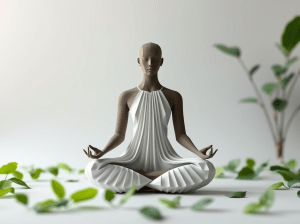
AI Generated Image
The exact mechanism used to distract ourselves isn’t that important. What is important is acknowledging that we can be better at accepting all of our emotions as being equally important. Take a moment and consider what your reaction is to the concept of emotional blockages leading to illness in the body.
For me, this idea has great value. And it really matters, not a jot, whether it remains a concept or becomes accepted fact. If we believe that emotions can become trapped in the body, and release and acceptance of these emotions helps us to feel better in the long term, this is what truly matters. I believe meditation, which leads to improved everyday mindfulness of how we avoid emotional wholeness, is key to our mental and physical well-being.
I’ve heard it said that mindfulness is about developing an empty mind. In a way this is correct
Even though I was a little taken aback by this, I feel it’s far easier and more constructive to not disagree, but to develop the idea. It is in fact impossible for the vast majority of us to empty our minds completely. Practice meditation for sixty years though, and there’s a good chance, you’ll be getting somewhere.
It’s going to be far more constructive to explain very clearly what in fact we’re looking to achieve through mindfulness. What we’re seeking is a single-pointed awareness of what we’re doing from moment to moment. Be this washing up, mowing the lawn, or walking the dog. During any one of these activities there can be happiness. And this happiness is brought about in the moments when the mind is empty of everything except what we’re doing. When the mind is empty of distracting thought.
What we must have, in order to consider ourselves mindful (better still, Mindfulness Practitioners), is a single-pointed awareness of the activity we’re currently engaging in. No outside thoughts, feelings or distractions whatsoever. When we have this we will have discovered the secret to happiness.
That’s right! Happiness is to be aware of the present moment. It’s when our mind is taken from what we’re doing right now that our happiness is destroyed. When our thoughts stray
These thoughts might be comparisons (if only I had this that or the other) or they might be worries concerning the future. Perhaps your thoughts are persistent or lingering – I would be happy if I did this or achieved that. Whatever the distraction, the answer is not an empty mind, but a mind that is empty of everything except what is happening right now. The answer is an awareness of the nature of your thoughts. The answer is to be mindful (aware) of your mind. To think about your thinking.
The only way to strengthen the mind, so that a single-pointed awareness is achievable, is through Meditation
During meditation we study our consciousness. We become aware of our thoughts and feelings and practise putting these things to one side. To do this we must constantly bring the mind back to our point of focus.
This need only be an awareness of the breath. Awareness of the difference in temperature between the in breath and the out breath is a great way to start. Just twenty minutes per day, at least three times a week, is sufficient. And the better we get, at bringing the mind back to our point of focus, the stronger our mind is becoming.
So much of poor mental health is down to fractured thinking. Good mental health relates to the strength of our mind. Thinking of the mind as a muscle helps. If we want stronger arms, legs or heart, we must engage in physical activity. Developing single-pointed awareness is the answer to strengthening our minds. Developing better focus, on one activity, to the exclusion of everything else, will lead to improved mental health and ultimately happiness
When we get right down to the heart of the matter it’s possible to remove so much of the wheat from the chaff
Starting with opinions. Ask: What is my opinion based on? Naturally the answer is knowledge. Your understandings of the world and most importantly your beliefs.
And so opinions are based on beliefs. What about thought? What is thought based on? A though might start with a feeling. You see in the news that an aeroplane has crashed and you feel upset. Fear is there. Anger is there. Wonder is there (someone survived). And then you form opinions based on your thoughts. What are your beliefs about the safety of aeroplanes? Do you believe they are intrinsically unsafe? If so, even though it’s a very rare event, your opinion might be; Oh my God, another one! Your beliefs will filter your opinions and, subsequently, your reactions. It might even affect you to the point of avoiding flying from this point on. At the extreme, you might become fearful of travel in general.
How would it be if you simply learned of the accident and managed to stop yourself from thinking and forming an opinion? How would it be if you understood the suffering of others through ambivalence (neutrality)?
Other peoples suffering is something we must be aware of. We decide how their suffering affects us. If we allow ourselves to become overly involved in the suffering of others we can also become lost. Far better to be one step removed (emotionally) and then seek to understand how suffering is generated and exacerbated. We can then offer this understanding to others.
There is a need to being removed from our opinions and emotions
Especially if you have no direct involvement. Ambivalence to the seeming chaos in the world is necessary for our own well-being. We find the ability to remain neutral and unaffected by tragic events through mental strength. Our mental strength will determine control over thoughts and opinions based on beliefs. The most effective method of improving how much control we have over our minds is meditation.
Meditation leads to improved mindfulness. Mindfulness is the awareness of our emotions and thoughts. Meditation is the study of our consciousness. Through becoming aware, we can control our thoughts and opinions, directly influencing our overall well-being. Well reasoned and measured reactions to events are a sign of our maturity and mental fitness.
What does your front door look like? Is it strong and sturdy? Or does it look like it could easily be broken down?
Where I work the door is mainly made of glass. It has an open sign in the window when I’m there. Very recently a lady called Mrs Hackaday called in to complain that we hadn’t been able to help her. To me she seems to have become a little fixated. She tells me she has recently lost her husband. Goodness knows where. And she tells me she used to be a psychologist. I mentioned I used to be a Hypnoanalyst. She didn’t stay long after that. Better results you see.
I feel it’s okay to have a glass fronted door where I work but wouldn’t want this kind of door where I live. I remember the door of my childhood home was at least 50% glass
Think of this: The greater my awareness the stronger my front door. It’s not as if I’m always hiding behind one of those little spy holes. Not at all. In fact, if I decide to open the door, I see the whole person standing in front of me. Disability and all. The question is whether or not I decide to open the door in the first place. The spy hole helps. My awareness helps me to make this decision. I ask If opening myself up to this person is of any benefit to me, or am I likely to be angered by their forgetfulness (lack of awareness).
I think of mindfulness as my beautiful front door. My mind safely protected behind
Yes. Protected. Because so many people are forgetful of their manners and seem intent on knocking very loudly. Even attempting to break down the door with a battering ram. But now? Not a chance. My awareness is my beautiful, sturdy, front door.
During meditation we can experience moments of realisation. During brief moments of silence, we realise that beneath all the chatter of our internal dialog, there exists a silent observer. We realise that this observer is our awareness. And at our core this is all that we are
It stands to reason, that from the moment of our birth, we have experienced many things. It is our interpretation of these events that shape and decide how we see the world. How others act and how they interact with our actions and behaviours, determine the opinions we form about ourselves, and others.
Initially, these things are ascertained from sights, sounds, tastes, and feelings. Do we feel threatened, or do we feel safe. We begin to ask: How must I act to continue feeling safe? What do I need to do to increase my sense of wellbeing, love, and security? What must I do to get what I want? Our beliefs and our identity (who am I?) begin to form from a very early age.
What we believe we are is the sum total of the beliefs formed from our experiences. Thoughts result from the vast belief systems that now exist within our minds. We are what we believe we are. Our internal dialog is there simply to compound our identity forming beliefs. Who are you in fact talking to?
During meditation we can ask this: Who was I just talking to? Was I talking to myself? Once our realisation holdsthat,beneath all the chatter there is only awareness, we begin to see how it is the minds beliefs that are creating identity. The next step in our development is to see the possibilities that are now forming. We can ask: If all that I am is this collection of beliefs, what beliefs must I lose and what beliefs must I start believing, to improve my quality of life?
It’s a certain fact, understanding the nature of our beliefs, causes them to become more fluid. We can realise they only belong to us because we’re choosing to compound them. Much of what we believe about our selves can either be redesigned or disposed of altogether.
Whenever I find myself feeling anxious or overly emotional, I remind myself, of what my skills of meditation and mindfulness offer me. The knowledge that I have these tools, easily at my disposal, instantly reassures me
It doesn’t matter what our age or circumstances there are going to be times when we feel troubled. It’s life. Life is meant to challenge us from time to time. It’s part of the process. It’s not possible for us to grow and experience the full kaleidoscope, of what life has to offer us, if we’re not occasionally challenged.
Meditation leads to an improved level of stillness and calm that comes from everyday mindfulness
It’s common nowadays for people to comment on how calm they find me. They describe me as a ‘calming influence’ and this is something I’m proud of. I’m proud because this has not always been the case. Quite the opposite in fact.
I have, in the past, allowed my emotions to control my actions. This can of course be disastrous. And so, as a result of improving my mental fitness – through daily meditation – I’m capable of being increasingly mindful. I’m mindful of how my judgments, opinions, beliefs, thoughts and emotions, influence my behavior and, above all, my choices. When I’m troubled, I take refuge in my practice. I dedicate time to calm myself before making decisions or taking action.
“I have nothing to prove and no reason to compete” he said. And I wondered what got him out of bed in the mornings
I decided to explore what he said, after all, he was up and about. I sometimes think there’s a danger to self-examination. That’s to say, looking to closely, at what motivates us. We can end up thinking that what motivates us is a negative. And when we remove that we start to struggle with finding the positives. Or a least finding positive motivators, that do actually get us out of bed, so to speak. I feel this is ever more prevalent when it’s been negative motivators that we’ve been working off all our lives. Needing to be liked, or loved, or approved of – being good examples. And yet, isn’t it these things that motivate most of us, most of the time?
So what can we see as a true, positive, motivator? Could this simply be love of life and what we do with it?
For the above to be true and sufficient to motivate us, I feel we do need reminding, occasionally, of what fundamental and essential aspects of life we must focus on. That being, the extraordinary nature, of life itself. The absolutely, magical reality, that we are here living, right now. That we, humans (and all life), are the children of a star only because that star has been stable for billions of years. That the exact position we are from this star – and that we have a stabilizing moon – mean the conditions for life, and for it to have had sufficient time to evolve, have been just right.
All of this means we are extremely rare. My personal opinion is that we may represent the only intelligent life in the galaxy. And that this brings a certain responsibility with it. The responsibility to actually live this life, to the best of our abilities, moment by moment. Is it the case, as suggested by people far more intelligent than I, that it’s our existence that gives meaning to the universe?
Mindfulness is certainly key to carrying this responsibility successfully
Can being reminded of the above facts (raising our awareness to them), be sufficient to get us out of bed, when we have nothing to prove, and no reason to compete? How about when we have no one to please except ourselves? I reckon I’ll meditate on all of these points tomorrow. How about you?
Something isn’t quite right. It’s hard for him to put his finger on. Is this feeling a craving perhaps? He wants something but doesn’t know what
This mind state is unsettling and most of us will seek to find a way to change it. Perhaps this will be through consumption or some other form of distraction. The key word here is distraction. Uncomfortable and unsettling feelings are often something we wish to distract ourselves from.
For the mindfulness practitioner, distraction is not an option, quite the opposite
When we decide to acknowledge everything we feel, and actively immerse ourselves in the feelings, we have a far greater chance of understanding the underlying causes. Feelings of craving can be the mind seeking distraction from something we’re not fully acknowledging. If we are hurt and angry it’s very important to work through these feelings and understand them fully. The anger might well have been caused by the actions (or non-action) of someone in our life and to feel angry might put us in an increasingly vulnerable position. If this is the case, we may seek to bury, the anger. It is this buried emotion that will create the minds need for distraction. The mind creates the craving to cure us. Of course this is no cure and may only, in the long term, add to our problems.
Take a moment to think about who has control of your mind if you’re burying anger and craving distraction as a result
It certainly isn’t you who has control. We could go as far as to say, it’s the person who you feel has wronged you, that’s in control. As a result of being mindful (aware) of our feelings – and the type of internal dialog we’re using to create them – we empower ourselves. Ultimately, it is our own thoughts that are creating the anger, not the actions of others. Through realising how we’re choosing to feel we are empowered to change. We take responsibility and we take charge. Remember:
As soon as you feel the craving for distractions stop and meditate. Meditating will improve your ability to mindfully acknowledge everything you feel. You will empower yourself to understand and change these feeling in a useful and constructive way.
With his little finger he gently stroked the little piece of skin just beneath her nose. He didn’t understand why he was drawn to doing this. She said, “are you messing with my symmetry?” He didn’t know how to respond to that. Some time later, after their love affair had ended, she moved away to a Greek island, got married, and had a family
Sit, cross legged, back straight, imagining a small piece of string gently pulling upwards from the grown of your head. There is a little strength in your abdomen, your lips are parted and your tongue is resting gently behind your two front teeth. Breathing through your nose now, noticing the temperature of the in breath, compared to that of the out breath. Your hands are resting inside each other in your lap, palms upturned, forming the shape of an empty bowl. Your aim today is to spend a short while focusing all of your attention on the area just beneath your nose. This is called the Philtrum.
In Jewish tradition, each embryo has an angel teaching it all of the wisdom in the world while it is in utero. The angel lightly taps the infant’s upper lip before birth to prevent the infant from revealing the secrets of the universe; the infant then forgets the Torah it has been taught
This focus on the Philtrum helps us to strengthen our concentration. When your mind wanders, and you become aware of this, gently bring your attention back to the Philtrum and continue . . .





 Practising Mindfulness